#HAPPINESSEXPERTS

Language
Español
#HAPPINESSEXPERTS
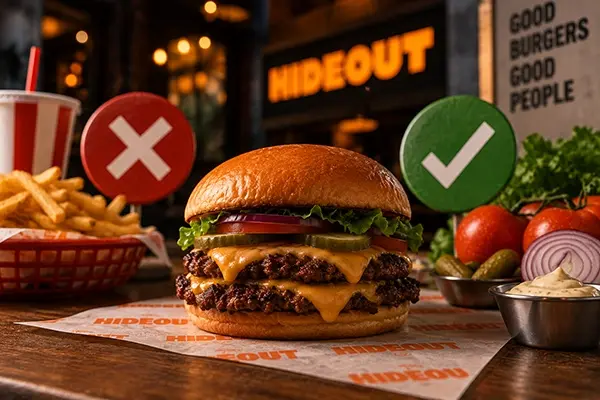
Just like pizza, burgers have long carried a certain stigma: being labelled as junk food. All it takes is seeing meat, cheese and sauce between two buns for someone to sound the alarm. But is it fair to put every burger in the junk food category?
The reality is that a burger can be made with very different ingredients and quantities, so before passing judgment and condemning it to a life alongside giant sodas and frozen fries, let’s take a look at what’s really behind this label.
“Junk food” is a colloquial term used to describe foods or dishes that are high in calories, saturated fat, sugar or salt and have little nutritional value.
The problem is that the label oversimplifies things. Not all foods are the same, and a meal can’t be judged solely by the number of calories it contains. To assess it properly, you need to look at its composition, the quantities involved and the role it plays within your overall diet.
The World Health Organization states that a healthy diet should be based on four principles: adequacy, balance, moderation and diversity. In other words, what we eat matters just as much as how much we eat, how often we eat it and what other foods we eat alongside it.
For example, no one would call a salad junk food, but what if it contains breaded chicken, bacon, cheese, croutons and so much processed sauce that you can’t even see the lettuce? That would change things quite a bit, wouldn’t it?
By definition, a burger isn’t junk food. In fact, in its simplest form, it contains bread, meat and different natural ingredients that provide protein, carbohydrates, fats, vitamins and minerals, all essential nutrients for our bodies.
What determines its nutritional profile is the whole combination: a simple burger with a lower calorie content isn’t the same as one with a triple patty and extra sauce, which will have a much higher calorie content.
Meat provides protein and other nutrients, although its fat content can vary. The bun adds carbohydrates, while vegetables provide fiber, vitamins and a fresh touch that, besides looking good in photos, actually serves a purpose.
Then come the usual suspects: cheese, bacon, caramelized onion and sauces. None of them turns a burger into junk food on its own, but the more we add, the easier it is to increase its fat, salt, sugar and calorie content.
If you want to get into the numbers, in our article about how many calories are in a burger, we explain why there’s no single number that applies to every burger.
The preparation method can also make quite a difference. Cooking meat on a griddle isn’t the same as deep-frying it in plenty of oil, just as adding a light homemade sauce isn’t the same as emptying an entire jar of supermarket mayonnaise over it.
In a smash burger, like the ones we make at Hideout Burger, the ball of meat is pressed onto a very hot griddle. This creates the Maillard reaction, responsible for that golden, crispy and flavor-packed crust.
The technique doesn’t turn the meat into a different food. It’s still cooked meat, although with a different flavor and nutritional properties.
The burger often gets singled out while the fries, dessert and, especially, large sug


